Gathic Era
At over 40 years of age and with the full backing of a powerful chieftain, Zoroastrianism enters what is termed the Gathic Era. This period, named for Zarathushtra's Gathas writing, spanned from c. 1500 to 1000 BC. The Gathas, which we will review in future articles, is a set of 17 sacred hymns composed by Zarathushtra in Old Avestan (Ancient Iranian) language.This period marked a radical religious revolution in the ancient Iranian world as polytheism transitions into one of the world's first documented monotheistic faiths.
The Gathic Era emphasized human reason, free will, and the ethical responsibility of the individual in their choice between truth and falsehood. Zarathushtra condemned the worship of the Old Iranian nature deities and gods of war. He instead focused attention on the worship of the "Wise Lord" the singular, uncreated, supreme creator. He encouraged his followers to act as "co-workers" of the Wise Lord by utilizing good thoughts, good words, and good deeds in their struggle to choose between two possibilities – Holy Spirit or Destructive Spirit.
At age 42, some twelve years after his revelation from the Wise Lord, Zarathushtra found himself as the chief religious advisor of a powerful chieftain. Vishtaspa, his wife, and much of the court and common people accepted Zarathushtra's teachings and his message began to reach a much wider audience. People from all over ancient Iran came to hear him speak. While his teachings were controversial, they were also revolutionary and life-fulfilling. He taught them about the true nature of existence, the existence of a Supreme Intelligence which created reality, and about the struggle between beneficial and harmful choices. He taught that the gods of the old ways were harmful to their lifestyles, that the priests were violent deceitful parasites who exploited and oppressed them. He held out hope that rulers should be good, ethical, and rule by the explicit consent of the governed. He also told them of the equality of men and women and that both should be allowed full autonomy over their lives.
He likely started some sort of school and started crafting his poetry that would become the Gathas for the purpose of educating his students. The term Gatha, initially a style of religious poetry that was either sung or chanted in a unique fashion, seemed to exist in opposition to the religious establishment. The Gatha style was frequently used by mystics, nonconformists, and folk-practitioners who might have been labeled as wizards or witches, much as Zarathushtra's mother Dughdove may have been.
Zarathushtra had many students and for many he would become their sage and guide who showed them a new and life-inspiring way to live. For some, however, he became a mentor who taught them how to reach and attain the divine in their own minds.
When he was about 60 years old, some 30 years after his revelation from the Lord of Wisdom, The Huns, the nomadic warrior peoples of the central asiatic steppes, initiated a massive war against Vishtaspa and ancient Iran. In the final battle, Vishtaspa's brother would die before the Iranians saw victory. After the victory Vishtaspa focused on increasing and improving his dominion while Zarathushtra continued to teach his message. During this time Zarathushtra names this system of understanding which he had received from the Lord of Wisdom as Vanguhi Daena meaning the Good Envisionment (or perhaps The Environment of Good).
This Good Envisionment is the core of Zoroastrianism. If his name is Zarathushtra, then why Zoroaster and Zoroastrianism? Zarathushtra was a cumbersome word for the Greeks so, in Greek, Zarathushtra is known as Zoroaster. You must admit that Zoroastrianism is much easier to pronounce than Zarathushtraianism! At least its fewer letters.
Zarathustra would pass away 47 years after his revelation at the age of 77 years old. One named Djamaspa would become the leader of the Good Envisionment for the next seventeen years, significantly helped by Freni, Zarathushtra's eldest daughter, and Ashanti, the son of Zarathushtra's cousin.
Ten years later Vishtaspa, Zarathushtra's chieftain, made a pronouncement across all the lands and two additional seekers of knowledge came to study Zoroastrianism. In the 248th year after Zoroaster's revelation it was prophesied that some great calamity would come to ancient Iran and put it into a century of darkness. Research indicates that this calamity occurred around 800 to 900 BC around the end of the Bronze Age in Europe. This is referenced as the Avestan Age and is dated from around 1000 BC to 330 BC.
The Avestan Age
After 625 BC the nature of Iranian civilization changed drastically into a decentralized feudalistic society with no centralized authority. The Iranians, or Airyans in their language were split across a number of different nations spread across the regions of Central Asia.
The Avestan Age can be split into three rough divisions:
The Early Avestan Period
This period is characterized by the darkness and the time immediately following it during the 400th year of the religion. In this period a language shift from the Old Avestan, the language of the Gathas, to the Young Avestan, a related, but distinct language. This period sees a syncretized adaptation of old Iranian gods into the religion of Zarathushtra. Basically, humanity rationalized their way into Zarathushtra's revealed faith.
The Middle Avestan Period
From about 750 to 550 BC this period sees the creation of a standardized and internally consistent religious, mythological, and theological system. What one today understands as Zoroastrianism is officially formulated in this time period. Humanity continues to "mix and match" theologies to suit their needs as the Iranian peoples spread further south, into central and southern Afghanistan and into northern Pakistan.
The Late Avestan Period
It is at this period, after some 200 years of prosperity where two Iranian nations which had formed in the west – Media and Persia (Medes and Persians) would form the largest empire the world had yet seen. This led to a massive increase in wealth, prosperity and development for the Iranian peoples. Zoroastrian and Iranian ideas would spread all across the world via the vast network of expertly maintained roads and travel ways connecting the known world.
The Medes and the Persians
Around 900 BC a large number of Iranian peoples migrated into the territory of modern Iran. In the Northwest the nation that would become known as the Medes, settled on the border of Assyria and formed a nation very similar to the Avestan nations, being a decentralized feudal alliance of lords or petty kings. They also had a specific type of priest called a magi who would eventually become famous synonymous with both Zoroastrianism and the very concept of magic.
To the southeast another Iranian nation would form, initially settling in and around the territory of the ancient Elamite state, living alongside their Elamite neighbors. When the Elamite state began to decline in the 700s BC these Iranians began to take rulership over many cities in the areas of Elam. These people were initially called the Parsu, but they would later be called the Parsa, or the Persians.
They had created a nation very similar to that of the Medes or the Avestan nations and they carried on a religion similar to the one of the Gathic period. They solely worshiped the Lord of Wisdom and the seven emanations radiating from him, and the natural world. They recognized no other deities and saw the divine to be fundamentally different from the physical world.
Somewhere in the early 800s BC the Medes became fully settled in their new land and would come into increasing conflict with the militaristic Neo-Assyrian Empire who had transformed Assyria from a regional power to a powerful empire expanding over much of the Middle East. From the 800s to 678 BC the Medes became famous in Assyria for being strong warriors with many horses who occupied vast lands that the Assyrians could never fully penetrate.
In 687 BC, after a series of Assyrian invasions, a local Mede ruler would form an alliance to throw off Assyrian dominion from their lands. In 672 BC a revolt would successfully free the Medes from the Assyrian domination. It would go on to unify all of the Medes under a single powerful empire until about 653 to 651 BC when the Scythian nomads, themselves an Iranian people group, conquered the Medes and ruled for 28 years until 625 BC.
At the same time the Assyrians entered a prolonged series of conflicts with the Elamites that would end with much, or all, of the Elamite and Parsa (Persian) land becoming vassals to the Assyrians. Elamite political power would nearly be completely broken. One of the Elamite primary cities would be captured by the Persians and the others plundered and burnt by the Assyrians in 647 BC. At this time a Persian chieftain started a new ruling dynasty and his son was Cyrus I.
In 625 BC the Medes once again united to drive out the Scythians and the Medes transformed into a large, powerful and well-organized empire. It may be said by some that this foundation of the Iranian empire, while changing over many dynasties over the centuries, would go on as mostly the same entity until the coming of Islam 1200 years later. It is more accurate to consider the different political dynasties as different dynasties of the same empire, given that they all occupied the same administrative structure, ruled over the same Iranian core with non-Iranian peoples on the periphery and, for the most part, carried on the same societal, cultural, and structural identity.
A decade after taking power from the Scythians the Medes formed an alliance with the Babylonians in order to finally deal with the Assyrian threat that had plagued both peoples for generations. In 615 BC they led an unsuccessful attack on the Assyrian capital of Nineveh, but very quickly the Medes would take Ashur, the ancestral home of the Assyrians and namesake of their national god Ashur. They completely destroyed the city. In 612 BC the Medes and the Babylonians would capture and sack Nineveh. The Babylonians and the Mede split the Assyrian lands, the Mede keeping Nineveh, Ashur and everything east of the Tigris River. The warring continued, even with the support of the Egyptian Empire, until 605 BC when Assyria would be completely conquered.
The Mede's empire grew in both wealth, power and territory. The dynasty changed in 550 BC when Persian vassal Cyrus the Great overthrew his Mede overlord establishing the Achaemenid Dynasty of Iran. Cyrus ruled until 530 BC extending his territories all across the ancient world, only stopping at Egypt and Greece.
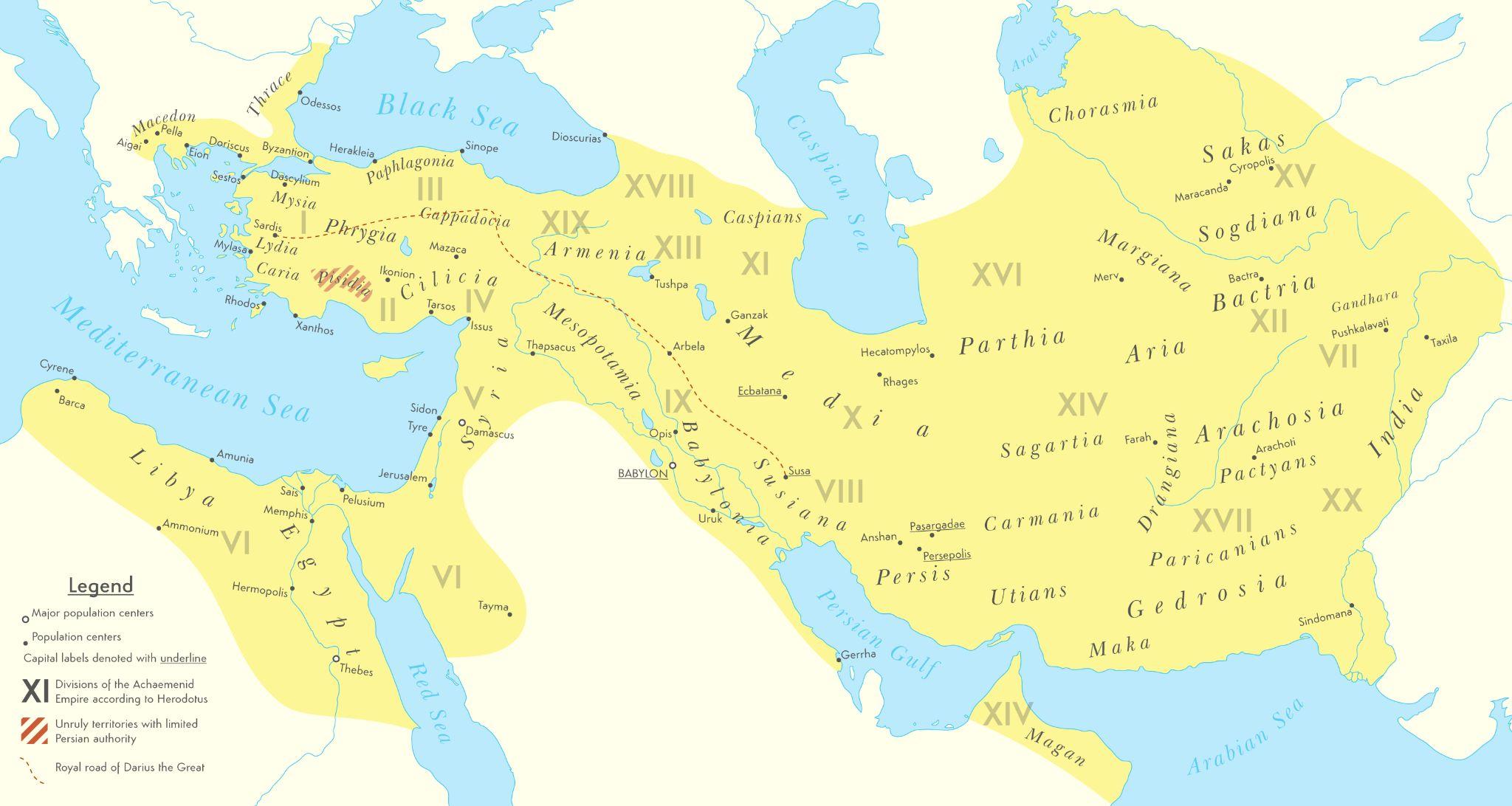
Later a young noble, Darius, would overthrow petty despotic Persian rulers, and proclaim himself the new king of the empire, putting down many rebellions in order to keep the empire intact. First Babylon and Elam would rebel against the Persians. Darius put their rebellion down. Soon after the Armenians, Medes, Parthians, Assyrians, Egyptians, Margianians and Scythians would be in open rebellion. Darius secured his empire and began to expand his territory to eliminate any threat to his empire. In 518 BC he invaded the Indus Valley and northwest India. He would go on to conquer areas in Anatolia and northern Greece including Macedonia. Darius would chase the Scythians all the way to Dnieper river (what we know as the boundary between Russia and Ukraine).
After ten years of war Darius returned home to focus on civil affairs, implementing an extremely efficient and robust bureaucracy to manage his empire. He also embarked on massive building projects. A royal road was built all throughout his empire, connecting Persian to Egypt, Greece, Bactria and India. The roads had regular rest points and guard posts, keeping them accessible and safe for all people of the empire. He also enlarged the city of Parsa into Persepolis
Darius was a Zoroastrian and spread Zarathushtrian ideas across the world recognizing concepts of beneficence and harmfulness, recognizing the one source of all, but they did not go so far as to denigrate or reject the gods of their constituent peoples.
Later in history, the core of Zoroastrianism would be geographically recentered and spread across the empire having effect on many religious traditions and even Greek philosophy. It was in 490 BC that the Greeks, at the battle of Marathon, defeated the Persians forcing their withdrawal back to Anatolia.
The empire would last for another 150 years after Darius, and other Iranian Dynasties would last another 1000 years until is was conquered by Alexander the Great in 330 BC. Zoroastrianism's decline in Iran was primarily driven by the 7th -century Arab/Muslim conquest of the Empire, which led to centuries of systemic discrimination, heavy taxation on non-Muslims, and incentives for conversion. This gradual process resulted in Zoroastrianism being replaced by Islam over several centuries.
The message of Zarathushtra, now some 3500 years old, has been waning for the past 2500 years. The system of thought that he gave, which would enable humans to iteratively work towards completion with divinity, is now obscure and typically misunderstood. Yet the truths remain and the message is still available to those who seek to understand the workings of the world.


 The Avestan Age


No comments:
Post a Comment
Be thoughtful, be helpful, be civil…